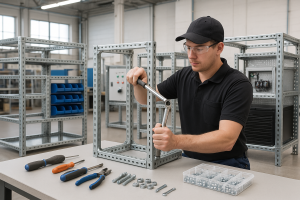
The main unistrut fittings are beam clamps, brackets, channel nuts, pipe and flange clamps, and splice plates. Each one bolts to strut channel to join, hang, or secure it to a structure. Match each part to your channel series and its load, and the frame goes together with simple bolted joints.
This guide covers what each part does and how to pick between similar parts. It also explains channel series compatibility, a common snag for buyers. The same advice fits strut fittings from Unistrut and similar strut and fittings systems, whether you buy one part or a full project package.
What Counts as a “Fitting” in a Strut System
A fitting is any part that connects to the channel. Any unistrut fittings catalog sorts strut channel fittings into four main families:
- Connecting fittings: flat plates, 90 degree angles, Z shapes, U shapes, wing fittings and brace fittings that join channel to channel.
- Structural attachments: beam clamps, flange clamps, post bases and concrete inserts that tie the frame to steel, floors or slabs.
- Pipe, conduit and tubing supports: clamps, straps and hangers that hold the load the frame carries.
- Hardware: channel nuts, bolts, threaded rod and washers that lock each joint in place.
Every family uses the same connection. A channel nut drops into the slot and turns 90 degrees. Its grooved face then grips the inturned lips of the channel.
A bolt passes through the fitting and into that nut. It clamps the fitting to the channel at any point along its length.
This is why one stocked size of P1000 channel can become a trapeze hanger, an equipment stand or a cable tray support. The fittings decide what the frame becomes.
Common Fitting Types (Beam Clamps, Brackets, Channel Nuts, Pipe & Flange Clamps, Splice Plates)
These five types make up most unistrut fittings orders on mechanical, electrical and industrial jobs. Each one solves one specific connection need.
Beam Clamps
Beam clamps attach strut or threaded rod to the flange of a structural steel beam. They grip the flange, so the building steel stays free of field drilling and welding. Many owners and engineers prefer this method.
Styles range from simple top flange clamps for threaded rod to wide throat and universal clamps for thicker flanges and heavier loads. Some models carry FM approval for fire sprinkler hangers.
We stock beam clamps for 1 5/8″ framing. Our beam clamp guide covers flange thickness, throat size and set screw installation in depth.
Brackets
Brackets project channel out from a wall, column or upright strut to form a support arm. Cantilever brackets carry pipe racks, cable tray and shelving. They come in slot-up or slot-down versions, so clamps can attach to the top or underside of the arm.
Length is the main choice, since capacity at the tip drops as the arm gets longer. Check the load table from the maker for your arm length. A slot up bracket in the 6″ to 24″ range suits most wall runs.
Gusseted angles and knee braces stiffen the corner as loads climb. Our guide to bracket types compares shapes and uses side by side.
Channel Nuts
The channel nut is the most ordered strut fitting, since nearly every joint in the system uses one. It shows up on almost every unistrut fittings order in three common forms:
- Spring nuts: the spring holds the nut in place inside upright or overhead channel while you line up the fitting. This is the default for most installs.
- Springless nuts: these are placed by hand on flat runs or in tight spots.
- Top retainer nuts: a low-profile option that drops in from the slot face.
Nuts are sized by bolt thread, from 1/4″ through 3/4″ for 1 5/8″ channel. Deeper channels need longer springs to reach the back of the channel. We carry spring-loaded channel nuts across the standard thread sizes.
Pipe & Flange Clamps
Pipe clamps hold pipe, conduit, or tubing to the channel. The common two-piece strut clamp snaps into the slot and closes around the pipe with a single bolt. A universal pipe clamp handles standard pipe sizes.
Cushioned clamps with a thermoplastic insert reduce vibration and noise. They also separate dissimilar metals.
Flange clamps grip the edge of a steel flange, so channel or rod can hang from it while the steel stays intact. A flange clamp is a common pick for retrofit work on existing steel.
Splice Plates
Splice plates join two lengths of channel end to end. They also tie channel together at a corner or tee.
Flat plate splices bolt across the joint on the slot face. Internal splices sit inside the channel for a clean profile.
A splice fitting extends a run past a stock length. Place splices near a support point, since bending peaks at midspan.
Choosing the Right Fitting for Your Application
Start with the connection, and the catalog choice will follow. Five questions narrow the right unistrut fittings for most jobs.
Unistrut Fittings Selection Checklist
- What are you attaching to? Steel beam: beam or flange clamp. Concrete slab: concrete insert or anchored post base. Wall or column: bracket. A second channel: connecting fittings.
- What is the frame supporting? Pipe and conduit runs need pipe clamps sized to the outside diameter. Cable tray and shelving need brackets or trapeze hangers. Equipment needs a braced frame.
- How heavy is the load, and which way does it act? Static, vibrating, and seismic loads each call for their own fittings. Seismic bracing uses dedicated brace and pivot fittings.
- What is the environment? Dry indoor areas suit electrogalvanized or painted finishes. Outdoor or wet areas call for hot-dip galvanized or stainless steel. Corrosive chemical areas often move to fiberglass channel and fittings.
- What will inspectors expect? Fire sprinkler, seismic, and some electrical work require listed or approved parts. Confirm the listing before you order.
Keep finishes consistent across channel, fittings, and hardware. Mixing a stainless fitting with a zinc-plated nut invites galvanic corrosion at the joint.
For structural work, check the published load data and bolt torque for each part. For complex designs, we read your blueprints and return a full parts list and proposal. We also offer cutting, kitting, and installation.
Fitting Compatibility Across 1-5/8″ and 13/16″ Series
Compatibility depends on channel width and whether the channel is deep or shallow. This one rule prevents most ordering mistakes with unistrut fittings.
1 5/8″ Series
All 1 5/8″ wide channels share the same slot opening and lip profile at every depth and gauge. That covers P1000, P1100, P3300, P4000, P5000 and P5500, including the shallow P4000.
One set of 1 5/8″ fittings and nuts works across the whole family. Depth affects only the channel nut spring, which must reach the back of the channel.
13/16″ Series
The 13/16″ series is a separate, lighter duty system. It includes P6000 (13/16″ x 13/16″) and P7000 (13/16″ x 13/32″) channel.
Its smaller slot pairs with its own fittings and its own 13/16″ nuts. Treat the two series as separate systems and order parts for each one on its own.
The naming can confuse buyers, since the 13/16″ series name refers to channel width. P4000 is 13/16″ deep and 1 5/8″ wide, so it takes standard 1 5/8″ fittings. A 1 1/4″ A series system also exists, with its own nuts and fittings.
Quick Compatibility Check
| Channel | Width | Uses |
| P1000, P1100, P3300, P4000, P5000, P5500 | 1 5/8″ | 1 5/8″ fittings and channel nuts |
| P6000, P7000 | 13/16″ | 13/16″ fittings and channel nuts |
| A1000 (A series) | 1 1/4″ | 1 1/4″ fittings and channel nuts |
To identify the series on site, measure the outside width of the channel. 1 5/8″ channel is about 41 mm wide, and 13/16″ channel is about 21 mm wide.
Matching parts to an existing install or building a material list from drawings? The Steinco team can confirm the right fittings and quote the full package. Call 419.606.8512, Monday to Friday from 7 am to 9 pm EST, or Saturday from 7 am to 3 pm EST.
FAQs
What fittings work with Unistrut channel?
Unistrut channel works with connecting fittings, brackets, beam clamps, pipe clamps, splice plates, and channel nuts. The key is to match unistrut fittings to the channel width. Use 1 5/8″ fittings on 1 5/8″ channel and 13/16″ fittings on 13/16″ channel.
Can Unistrut parts fit strut from other brands?
Most 1 5/8″ strut channel from major makers shares a similar profile, so parts often fit across brands. Published load ratings apply to each maker’s own tested combination. For engineered or inspected work, keep channel, fittings, and nuts from one system.
What is the difference between a spring channel nut and a springless nut?
A spring nut holds itself in place inside the channel. This makes upright and overhead installs much easier. A springless nut is placed by hand and suits flat runs or tight spots, and both lock to the channel lips the same way once the bolt is tight.
Which fittings go with 13/16″ channel?
The 13/16″ series, P6000 and P7000, has a smaller slot. It uses its own fittings and channel nuts. P4000 channel is 13/16″ deep and 1 5/8″ wide, so it takes standard 1 5/8″ fittings.
What size bolts do strut fittings use?
Most 1 5/8″ connecting fittings are punched for 1/2″ bolts. Channel nuts for 1 5/8″ channel come in thread sizes from about 1/4″ to 3/4″. Confirm the hole size on the submittal for each part before ordering bolts and washers.
How do you attach strut to a steel beam?
Use a beam clamp or flange clamp that grips the beam flange. It tightens with a set screw or bolt, so the building steel stays free of welds and holes. Choose the clamp by flange thickness, rod or channel size, and load.
What is a strut clamp used for?
A strut clamp holds pipe, conduit, or tubing to the channel. Most styles snap into the slot and close with a single bolt, and cushioned versions reduce vibration and noise. Our primer on Unistrut clamps covers the main clamp styles and sizing.
Which finish suits outdoor strut fittings?
Hot-dip galvanized fittings are the common choice for outdoor and damp locations. Stainless steel suits harsher or washdown areas, and fiberglass suits chemical or highly corrosive spaces. Match the finish of channel, fittings, and hardware to prevent galvanic corrosion.
Can Steinco help build a fittings list from drawings?
Yes. We read your blueprints and return a full parts list with a proposal. We also offer cutting to length, preassembly, kitting, and installation for unistrut fittings and channel.