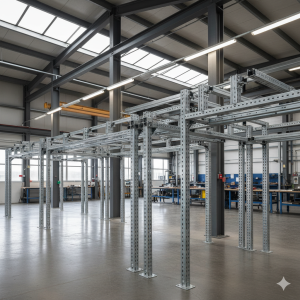
A Unistrut bracket connects strut channel to a wall, ceiling, beam, or another piece of channel, and it carries the load at that connection point. Because that one joint often decides whether an installation holds up over time, picking the correct bracket type matters as much as picking the right channel size. This guide walks through the most common Unistrut bracket types, explains where each one performs best, and gives you a straightforward way to match a bracket to your specific application.
Steinco Industrial Solutions has distributed Unistrut metal framing components for more than three decades, and our team regularly specs, cuts, and pre-assembles brackets for contractors and facility managers who need a system that fits the first time. The guidance below reflects that hands-on experience, not just a parts catalog.
What Is a Unistrut Bracket?
A Unistrut bracket is a formed steel fitting that attaches to strut channel through the channel’s slot, then extends outward to connect to a wall, another channel run, a pipe, or a piece of equipment. Since Unistrut channel comes in three standard sizes (1-5/8″, 1-1/4″, and 13/16″), brackets are manufactured to match each size family, and a bracket built for one channel size will not seat correctly in another.
Most brackets are stamped or formed from 12-gauge or 14-gauge steel, then finished for the environment they will serve. Because the bracket is often the weakest link in a support assembly if it is undersized, matching bracket gauge and finish to the load and setting is not optional; it is the first decision you make.
The Main Unistrut Bracket Types
Unistrut brackets fall into a handful of recognizable families. Although manufacturers list dozens of individual part numbers, nearly every one belongs to one of the categories below.
Flat Plate Brackets
Flat plate brackets are the simplest style: a single flat piece of steel with mounting holes, used to close off a channel end or create a flat mounting surface. Contractors typically reach for these when they need a clean, low-profile connection point rather than a load-bearing arm.
Angle Brackets (90-Degree Fittings)
Angle brackets, sometimes called angular fittings, join two pieces of channel at a right angle or anchor a single channel run to a perpendicular surface. Since a 90-degree joint is the most common structural connection in framing work, angle brackets are usually the highest-volume bracket type on any given job.
Hinge and Adjustable Brackets
Hinge fittings allow a connected channel or panel to pivot rather than lock rigidly in place. Installers use them for access panels, folding supports, and any application where the angle needs to change after installation, such as a bracket that swings out of the way during maintenance.
U-Shape and Wing Fittings
U-shape fittings wrap around a channel or pipe from three sides, which spreads the load across a wider contact area. Wing fittings extend at an angle from a single mounting point and typically support cable trays, conduit runs, or light equipment that hangs slightly off the channel line.
Post Bases and End Caps
Post bases anchor a vertical channel run to a floor or slab, while end caps close an open channel end to keep debris out and protect installers from a sharp cut edge. Neither carries much structural load on its own, but both round out a complete assembly.
The table below summarizes how these types compare.
| Bracket Type | Typical Shape | Best For | Adjustable? |
|---|---|---|---|
| Flat Plate | Single flat plate, pre-punched holes | End caps, simple mounting surfaces | No |
| Angle (90°) | L-shaped, two mounting faces | Perpendicular channel-to-channel or channel-to-wall joints | No |
| Hinge | Two plates joined by a pivot pin | Access panels, swing-away supports | Yes |
| U-Shape | Three-sided wraparound | Pipe and conduit cradling, wide-load spreading | No |
| Wing | Angled single-point extension | Cable tray and conduit hangers | Limited |
| Post Base | Flat plate with anchor holes | Floor or slab-mounted vertical runs | No |
How to Choose the Right Bracket for Your Application
Once you know the bracket families, the next step is matching one to the job in front of you. Because every application places different demands on the connection, work through these factors in order rather than picking a bracket by appearance alone.
- Load direction. If the load pulls straight down, a simple angle bracket often works. If it pulls outward or sideways, a wing or U-shape fitting resists that force better.
- Need for movement. Choose a hinge fitting whenever the connection has to pivot, fold, or open for access; a fixed bracket will crack or bind under repeated movement.
- Channel size compatibility. Confirm the bracket matches your channel size (1-5/8″, 1-1/4″, or 13/16″) before ordering, since a mismatched bracket will not seat in the channel slot.
- Mounting surface. Concrete, drywall, and structural steel each call for a different anchor style at the bracket’s far end, even though the bracket itself may be identical.
- Environment. Outdoor, washdown, or corrosive environments call for a different finish than a dry indoor mechanical room, which the next section covers in more detail.
A few common applications illustrate how these factors play out in practice:
- Overhead pipe and conduit support: U-shape or cushioned clamp-style brackets cradle the pipe while spreading weight across the channel.
- Wall-mounted equipment: Angle brackets anchor the channel frame to the wall, then flat plate brackets close off exposed ends.
- Rooftop and solar mounting: Wing fittings or specialty roof brackets connect channel to standing-seam or membrane roofing without penetrating the surface.
- Seismic bracing: Adjustable hinge fittings allow a brace to absorb movement during a seismic event instead of transferring the full force into a rigid joint.
Material Finishes and Corrosion Considerations
Because a bracket sees more direct exposure than the channel it connects to, its finish deserves as much attention as its shape. Unistrut brackets typically come in one of these finishes:
- Electro-galvanized (EG): A thin zinc coating suited to dry indoor environments with light corrosion exposure.
- Hot-dip galvanized (HG): A thicker, more durable zinc coating for outdoor use, washdown areas, or humid environments.
- Stainless steel: The best option for food processing, chemical exposure, or coastal installations where corrosion resistance is critical.
- Perma-Green: A painted finish that offers moderate protection along with a consistent, marked appearance across a large installation.
If you are unsure which finish your project needs, compare it against the channel finish you already specified; mismatched finishes on the same assembly can accelerate corrosion at the connection point through galvanic reaction.
Installation Best Practices
Getting the bracket type right only pays off if the installation itself is sound. Keep these points in mind on-site:
- Always seat the channel nut fully in the slot before tightening; a partially seated nut will not develop full holding strength.
- Tighten fasteners to the bracket manufacturer’s stated torque rather than “as tight as possible,” since overtightening can deform lighter-gauge brackets.
- Support long channel runs at regular intervals rather than relying on end brackets alone to carry a distributed load.
- Inspect brackets in vibration-prone environments periodically, as repeated movement can work fasteners loose over time.
Frequently Asked Questions
What is the difference between a Unistrut bracket and a Unistrut fitting? In practice, the terms overlap. “Fitting” is the broader industry term for any component that connects to strut channel, while “bracket” usually refers to fittings that extend outward to support a load rather than joining two channel pieces directly.
Can I mix bracket finishes on the same project? You can, but it is best to avoid mixing dissimilar metals at a single connection point, since contact between certain finishes can accelerate corrosion. When finishes must differ, isolate the contact surfaces where practical.
Do all Unistrut brackets fit every channel size? No. Brackets are manufactured for a specific channel width, so a bracket sized for 1-5/8″ channel will not seat correctly in 1-1/4″ or 13/16″ channel. Always confirm channel size before ordering fittings.
How do I know if I need an adjustable bracket instead of a fixed one? If the application requires the connection to move, pivot, or fold after installation, such as an access panel or a seismic brace, choose an adjustable hinge fitting. If the joint is permanent and rigid, a fixed angle or flat plate bracket is typically the more economical, durable choice.
Are Unistrut brackets OSHA compliant? Unistrut components, including brackets, are manufactured to meet OSHA-compliant design standards when installed according to manufacturer specifications and applicable building codes.
Get the Right Brackets the First Time
Choosing among the available bracket types is easier once you know the load, movement, and environment your project involves. If you are still narrowing down the right fit, Steinco Industrial Solutions can help. Our team has specified and pre-assembled Unistrut brackets for contractors and facility managers for more than 30 years, and as a GSA Multiple Award Schedule contract holder, we also supply federal and defense projects directly. We cut strut to length, pre-assemble fittings, and handle custom fabrication so your bracket assembly arrives ready to install rather than ready to sort through.
Contact our team with your application details, and we will help you match the bracket type, finish, and channel size to the job.